Friday, June 26, 2015

16 Things Nobody Told You about Type 1 Diabetes


Whether you're a loved one, friend, or struggling yourself with this disease, the type 1 world can be confusing, frustrating, and downright hard to be a part of. Information is confusing, and the disease itself can feel stigmatizing and isolating...which leads me to my first point.

1. Type 1s often lack community (especially adults). Have cancer? You can find about a million facebook groups, support groups at local hospitals and treatment centers, 5k races, chat rooms, and other methods of community, all organized around the idea that "we can fight this together!" But with Type 1s? Good support groups are out there, but they are hard to find, and largely organized around caregivers of T1s. And if you are struggling yourself with it as an adult, the community options are even smaller, because T1s don't have any hope for a cure. While cancer can go into remission through various treatment options, T1 is a 24/7 disease that requires constant monitoring, and there's little hope for a true cure, which always seems "ten years away..." This creates despair and isolation, and before I created the Facebook group Type 1 Diabetic Adults, I couldn't find one group dedicated to T1s themselves.

2. It's no longer considered "juvenile diabetes." Because adults can get it too, I'm one of them. It was originally labeled that before there was a real understanding of what caused it in children. Now they know T1 to be auto-immune, and onset can happen at any time. Despite that, many T1 adults get misdiagnosed T2 at first, only to land in the hospital when diet and exercise don't calm their high sugars. The more we can eradicate this misnomer, the better for us all!

3. We live in a Type 2 world. I was surprised at the lack of knowledge people had about type 1. Before my diagnosis I'd known about T1 and the differences between that and T2, but since diagnosis I've realized that many people don't. Commercials, public service announcements, media...they all talk about T2 diabetes. I even saw a news story recently about T1 research for a cure and at the very end they panned to a video of overweight adults. The newscasters themselves didn't know the difference between the two and those are the people educating the public at large! *facepalm*

4. Type 1s can be overweight. Most posts like these include that T1s don't necessarily look like diabetics and are thin, and while that's often true, some are overweight. T1 is an Auto Immune disease and many of us have other diseases that can affect our weight. We need to stop body typing and going on blood tests like Anti-Gad and C Peptide instead--we'd have far fewer misdiagnoses this way!

5. Onset is often slower than you might think. Research shows that some children diagnosed with T1 actually started showing signs that went unnoticed years before their diagnosis date. While many children and adults are diagnosed after traumatic events or other illness, there is research that onset can take years.  If your child or loved one shows signs such as sluggishness, frequent illness, lethargy, thirst, or hypoglycemic episodes, see your physician as soon as possible.

6. You have to be your own advocate. The truth is there is new research on Type 1 happening all the time, with new and innovative treatment methods and medical devices. Doctors don't have the capacity to keep up, so research your disease, read medical studies, and keep up to date with technology. Don't rely on your doctor to know the newest and best treatment methods---rely on yourself. Read diabetes blogs, get on newsletters, get in community, and read all you can---then ask your doctor about them.

7. Know your own body. YOU (or your loved one) deal with this on a day in/day out 24/7 basis, therefore you should start noting patterns, and tweaking treatment on your own, because the reality is your doctor can only know what you tell them at your visit every three months (or however often you go.) You are in charge of your own wellness because only you can spot the patterns and shifts that happen throughout the day. If you are new, please consult your physician before making any major changes, but as you get experienced you'll realize that the necessity to take charge of your own disease is paramount.

8. You will be misunderstood. "Can you eat that," is the most common question a T1 will ever hear, because people don't understand the differences between Type 1 and 2 and or what causes them. Other questions include..."Have you heard about this new cure" (insert cinnamon, pickle juice, or unicorn pee...), the world is always trying to sell us some new natural cure. The good news is you can kindly educate those around you and the more you do, the more misconceptions you'll be able to confront!

9. A CGM (Constant Glucose Monitor) really is your best friend. Honestly, this little device saved me. Instead of taking out my kit to check 6-8 times a day, I'm able to see my trends in almost real time, so if I'm in a meeting or appointment and going high or low, I can treat it right there (thank you pump therapy) without anyone really noticing.

10. A pump is your other one. If you are a busy adult, the pump is your other best friend in this disease. In a meeting and trending high? With the push of a button, you can discreetly treat yourself without interrupting anything or walking out of the room, or having to explain why you are getting out that pen or syringe. It keeps me feeling like a semi-normal person, which helps my sanity because..

11. This is a 24/7 disease. There is no break. I've thrown fits and chosen not to treat, only to end up sick and wondering, "why'd I do that again?" The trick is to find things that work for you, that will make life easier. Work smarter, not harder! The good news is there are so many tools, devices, apps on phones, and other things that do make like with T1 easier.

12. Seek out community. Just because it's not easy to find, doesn't mean that you don't look for it. When I saw there were no adult T1 groups on Facebook, I changed that and created my own. You can too. You can contact your local endocrinologists and see about starting a support group, you can seek people out on facebook or other websites, you can go to Diabetes retreats which do in fact exists! If you are a caregiver, there are sites for you too, and camps to sign your kids up for! Community has been my lifeline and it will be yours or your loved ones too. There may be no cure, but that doesn't mean we still can't fight and overcome this together. Overcoming just means something different to T1s. It means learning to live life as normally as possible without letting this disease define or limit you. That's my ultimate goal, and to do that you need others who get what you are walking through.

13. Seek out emotional help. Whether you are an adult with T1 or a caregiver/child, you'll need emotional help navigating this disease--grieving it, and grieving that life will look a bit differently. Grief has 5 stages including anger and depression, and it's okay to let yourself go there. What's not okay is to stay in those places and get stuck. That's when you need to reach out for help. Diabetes Educators are not only great tools for treatment, but many have T1 themselves and can offer advice and an ear. There are also many counselors who would be happy to walk you through grieving stages and come up with helpful ways to be an overcomer. Seek out friends, especially other T1s who could serve as sounding boards and safe places. Basically, you are NOT alone in this. If you need help, ask for it. Caregivers, spouses, this goes for you too.
 
14. You are at risk for other diseases. Associated AI conditions of T1 include Celiacs, Addisons, and Hashimotos. T1 is an Auto Immune disease, and AI diseases are often systemic, attacking more than just one organ. Which leads me to...

15. Build a treatment team. You need a good endocrinologist for basic treatment, but you'll also need an opthamologist, a podiatrist, a Diabetic Educator or nutritionist, and (see above) probably a counselor. Not too mention a good personal support system.

16. This isn't the end. While I won't tell you to make lemons out of lemonade, I'll say that while diagnosis with T1 changed the way I do life, it didn't end it. I know it feels like that, and it might for awhile as you grieve (caregivers and spouses too), but eventually you get in a routine and find what works for you, and there are days that you might actually feel normal!

Ignorance, despair, and isolation are the enemies of every T1 so do your research, connect with others, and build up a support system. There are great blogs, books, and communities out there that will help you on your journey through this mad world.

Saturday, May 2, 2015

Onederland Review: One Drop iPhone App Continued....


You know what's better than a good app coming out for Diabetes? A CEO who will personally respond to our T1 needs and is a T1 himself! Below is the response from the One Drop CEO to my post and email--and it's a good one! I do think a quick fix of simply giving us the ability to program in basal rates and add carb counts would negate needing medical company buy in or integration (which can be impossible.) But the response below is heart warming!

Thanks Alex,
We appreciate you taking a look. Thanks!
I too am type 1, so I understand all of your concerns.
We are able, willing, and ready to integrate pump users insulin data, but as you know - the device manufacturers are slow to allow access to any monoline source data. That is changing and you will soon see companies like Insulet integrated into One Drop.
Same thing for data sources like myfitness pal. Very quickly you will see options on One Drop for adding more detailed meal variables and have them auto import from your favorite logging tools.
There is no lack of understanding of type 1’s needs, just a desire to help create a positive, empowering, and motivational experience for anyone with diabetes to begin to make better choices and learn from each other. Do we fail to meet the needs of a type 1? Absolutely not. The majority of Type 1’s are not on pumps or CGM’s, so please reconsider your comments. I use the platform every day.
So, with 345 M people with diabetes and 30 M type 1’s and maybe < 3M people in total with pumps or CGM, we needed to think about the right mix of features and functionality for the 1st release of One Drop...
Did we get it 100% right? No. Did we make it with love? Yes.
I’m hoping you’ll keep the constructive suggestions coming so that we can continue to improve the experience, and I hope you’ll give us a chance to show that we have a new way of looking at the lonely, disempowering, and depressing state of diabetes care in a new way, and encourage people to begin to feel like diabetes badasses.
Thanks,
Jeff
Jeff Dachis
CEO and Founder
One Drop
Informed Data Systems, Inc.
Jeff@onedrop.today

So kids, look out for this amazing app. It will improve, especially if we keep sending in feedback. What can you do? Email Jeff and let him know what us T1 pumpers need! Give him ideas about how to work around getting integrations from other companies! Let him know how great he is doing too, and show them a little love for providing a place for us all to connect! 

Onederland Review: One Drop iPhone App


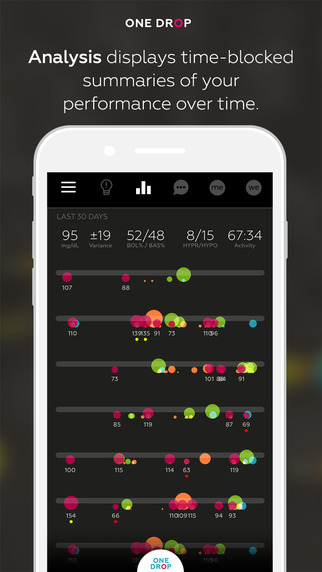
One Drop is the newest diabetes application for the iPhone (no word yet for android users) and it's currently free to download. Touted to be a helpful tool where one can store BGs, Food, Insulin Doses, and Exercise, and see them at a glance, I was excited! I'd tried Mysugr but found it wanting, and ever since I've been looking for an application that can truly store it all. (**Ahem** Diasend, that means you! If you could turn your website into an app I'd be loyal forever! )

User Friendliness:
One Drop gets an A for that. It's completely user friendly, with a helpful tutorial once you sign up, but even without it, the application is self explanatory, and it isn't too hard to figure it out on your own.

I loved the look of the "me" and "we" areas. Think of it like Facebook for Diabetes--the "me" portion is your own user page, while the "we" is your newsfeed for everyone else. I thought this was ingenious because at a glance I could see how others in One Drop were fairing and it instantly created a sense of community. It's hard to feel alone or isolated as you see others numbers.

T1 Diabetes Friendliness:
Here's where I'm going to be picky, because this app was made for both T1 and T2 users. I can see how for T2 users, this application is perfect, but as we all know, T1 needs differ--and this is just one more example of how both the medical and technological community fail to understand the differences.

  • Insulin Logging: For T2s, the way this app logs insulin is great, but for T1 pumpers, this app fails to meet our needs. You have to manually put in your basal rates--and there's no way to do it for the whole day, or to program into it what your normal rates are. So you literally have to plug in you basal rate by hitting the "meds" button over and over again making 24 separate entries for each hours and you must do this each day....talk about time consuming! If you don't do it this way, but simply enter in your basal rate all at one time (like I normally use about 58 basal units through my omnipod a day), it registers you as using that all in one hour, and the flow chart gets off base, which defeats the whole point of the app--to give you an accurate view of your day.  This is a HUGE miss, and would be so simple to fix. For those on pens, this would still work for you well. 
  • Meal Logging: For T2s who aren't religious in carb counting, this application is perfect. It has you take a picture of your food and say if your meal was "low, medium, or high" carb. However for T1s this is another HUGE miss. We have to be so careful about carb counting for insulin dosing purposes and there's no way to really put nutrition values in the meal portion, which is a miss for me. I'd still need to use an app like MyFitnessPal to accurately put in my nutrition values and carb counts.
All in all, this app gets a C for T1 Friendliness. It may be helpful to those still on pens, but for a pumper, it's a nightmare, and it's a great example of how the Diabetes world still tries to lump T1 and T2 together, without realizing the differences in treatment needs.

I hope that One Drop hears the T1 cry and fixes the things above because if they did, it would be a perfect application for the T1 community! Until then though, it's too hard to keep up with to be useful.


Thursday, April 23, 2015

High Maintenance


Diabetes is kind of like having a child. It's always on your mind. It asks for care 24/7 and just when you think you can sit down....BAM...it has another need.

Honestly, my dog is less high maintenance.

Did I bring enough snacks?

Do I have enough insulin?

Did I bring the medical tape? My CGM sensor is looking loose.

What does the ??? mean on the receiver screen?

Why is my BG so high? What did I eat?

Did I pre-bolus? I can't remember now! 

It's beeping! What does that meeeeean?!
I hate this because I've become quite the high maintenance molly, and I feel like I'm inconveniencing everyone. Where I used to be free-spirited and could go with the flow, my disease literally won't let me anymore. It consumes my thoughts, not because I'm obsessed but because it always needs attention.

I'll give T1 this much. It's hard to be a people pleaser and have it. Because in order to take care of it, you have to not care what people think.  You can't please everyone...you can't nurse your baby and make everyone else's demands...something has to give.

And it won't be me. 

What about you? Has it made you high maintenance? How have you dealt with it? As a supporter, do you realize how much your spouse/child/friend thinks about their disease?


Wednesday, April 22, 2015

My Diabetic Bag Essentials

Being a diabetic has stretched me in many ways, but nothing has been so stretched as the size of my purses. The first few months I struggled with what to carry, and got in trouble when I didn't have this or that with me, so now I have a list, and here's what I carry:


PDM Case with Dexcom pocket
  • PDM
  • extra needle for my pod (taken from another pod kit instead of throwing it away.)
  • extra strips
  • extra insulin
  • lancet 
  • dexcom receiver
Separate Diabetic Bag
  • medical Tape
  • extra Pod
  • glucose Tabs
  • nuts and dark chocolate in a baggie
  • Purel hand sanitizer
  • alcohol swab
  • humalog pen (just in case)
  • extra batteries
  • dexcom wall charger and USB 
  • extra tegaderm strips
These are my essentials and I go nowhere without them, so basically I carry two bags with me at all times in a very large purse.

What about you? what are your essentials?

Monday, April 20, 2015

The Blame Game


I work in ministry and have for about eight years and I've noticed something about people when it comes to pain.

I first noticed it with emotional pain, because that's what I work with the most. Often, people would be going through very real, very hard emotional issues--sometimes attached to events, sometimes not. But more often than not, the people who came to sit in my office would complain about one thing; their support system. Often the people around them would try and blame the hard situation they were walking through on them... "well if you'd just _____, that wouldn't have happened to you." Rape is a good example. Women are often asked about what they wore, or how they acted, and many will say "well, you asked for it."

I call it victim blaming, and I've noticed the same thing happens with chronic illnesses like Type 1, and I think it happens for the following reasons:

  1. Ignorance. Not everyone is like me and loves to research. I read articles on everything from faith and health to politics, and so when I was diagnosed with Type 1 I knew immediately the differences between that and Type 2, I'd read about it long ago. But as I began to explain to people what I had, I realized most people didn't know...they didn't realize that you could get T1 as an adult, nor did they realize it had nothing to do with what one ate, but was caused by auto-immune issues. This is the most forgivable because the blame is accidental. They genuinely usually care, and just want to give you the advice they know---eat right, exercise, etc---in order to help you get better. These are usually the people who constantly ask "can you eat that?" "Should you be doing that?" But their hearts are pure, despite the lack of information.
  2. Fear. Watching someone you love go through a hard time is painful for a myriad of reasons. One, they want to fix it, as much for them as you (so that their pain will stop.) Two, you having a chronic illness for no reason reminds them that they could wake up one day with it, or their kids could, and that's a scary world to live in or acknowledge, and so often people assign blame in their minds because it makes them feel better. "Well if Alex wasn't overweight she wouldn't have gotten T1, so I don't have to worry about getting it!" This is harder because they may not even realize why they just rationalized your disease, they may not be able to verbalize their fear.
  3. Lack of Empathy. Empathy is one of my number one gifts, it's easy for me to dive into someone else's world and try to understand it. But I'm realizing how rare this is, mostly because our culture does a poor job of valuing it so children don't learn to do this. Because of that, it's easy for people to assign blame or minimize the seriousness of this disease. Empathy is a choice, and something most people have to practice, so as long as people are willing, I have grace.
Now, knowing the above doesn't make getting victim blamed easier. But it does help us with a plan of attack. If I know it's ignorance, I try to kindly educate the person I'm talking to. If it's fear, I'm a big fan of calling out the covert and making it overt...ie. "I know it's scary to think that you could one day wake up and your child could have T1 because her immune system attacked an organ...it's even scarier to live." Acknowledging fear makes it less scary...I also usually throw in a joke to lighten the blow of that. If it's a lack of empathy though, I evaluate how important having that person is in my life, because if they cannot empathize, they aren't a life giving relationship.

If anything T1 has made me look at my relationships and question who is worth keeping. Who is good for my health? Who gives me life? Having a chronic illness has shifted my priorities and I've come to realize that I don't have time for people who don't give me life. That sounds harsh, but stress shoots my blood sugars up, and so in a tangible way, I don't have room in my life for stressful or life sucking friendships.

And that's okay. It's called priorities and for the first time in my life, I'm putting myself at the top!

What about you? Have you experienced victim blaming? How did you handle it?

Saturday, April 18, 2015

My Mad World


When I was a teenager I loved the movie Donnie Darko, especially it's theme song--Mad World.  I'd sit and listen to that song over and over again, marinating in my own teenage angst, sure that this song had perfectly captured my misunderstood life.

All around me are familiar faces
Worn out places, worn out faces
Bright and early for the daily races
Going nowhere, going nowhere
Their tears are filling up their glasses
No expression, no expression
Hide my head I wanna drown my sorrow
No tomorrow, no tomorrow
And I find it kind of funny
I find it kind of sad
The dreams in which I'm dying are the best I've ever had
I find it hard to tell you,
I find it hard to take
When people run in circles it's a very, very
Mad world, mad world
 
 Years later, I'm sure of it. Except now I'm not talking about teenage angst and brooding. Now it describes something wholly other.
 
Three years ago I started to feel funny. My head hurt, my tiny bladder got even tinier, and any time I ate, I felt like I was running through a fog. I went from doctor to doctor trying to figure out what was going wrong with my body. Most just looked at my weight and said, "lose it." Almost no doctor took me seriously, thinking my symptoms were all in my head, or attributing them to the fact that I was overweight. 
 
Let me step back for a minute. I've had health issues since I can remember. When I was three years old, I was growing too fast and I was taken to my very first endocrinologist to test my adrenals. When I was a teen, me period went mysteriously missing and became almost nonexistant, and I started gaining weight even though I wasn't overeating. As a young 20 something, I was diagnosed with severe endometriosis, Hashimotos, and what they thought was pre-diabetes (type 2). My body had always betrayed me and I never felt quite normal. 
 
Back to my three year search....it ended quite antithetically with me giving up. Nobody was listening to the fact that I thought something was wrong. It was the most helpless I'd ever felt and I didn't know how else to assert myself, so I stopped. Last year I had some route blood panels done by HDL Labs, a place that partnered with my doctors office, where one of my best friends was a PA. The results came back and even then, nothing was terribly wrong, or so they'd told me. Finally in exhaustion I sat down with a woman I'd met at my church who was a nutritionist with this company, and she immediately gasped at my results...
 
"Uh, did you know that you're a type one diabetic?"
 
My vision went black. What? How many hundreds of doctors, including my most recent one, had missed that it was diabetes and not only that, but type 1 (the kind kids get!) She pointed to my high fasting glucose and HBA1c results, as well as my astronomical Anti-Gad results. She said I was lucky I hadn't gone DKA in a hospital. She saved my life that day. 
 
Immediately I found an endo. The first one was a disaster and wouldn't listen to me...sure that my tests were wrong. So, I got online and found a diabetic specialist who told me it was the highest Anti-GAD result she'd ever seen and that in a few months, I probably would have been hospitalized.  She listened, and even knew all the research behind Adult Type 1 diagnosis, which I'd been consuming in the weeks since that fatal meeting with my sweet nutritionist friend. 

It wasn't long before I was on a pump and a CGM, seeing my endo and a Diabetic Educator (who herself had type 1) monthly. 
 
And now, I'm here, in this unfamiliar world of IC rations, carb counting, and other terms that I'm learning to use fluently. And that song rings true more than ever....type 1 diabetes is my mad world, and I'm still exploring it, much like Alice in Wonderland. I'm like a toddler, finding my legs on wobbly and unfamiliar ground, trying my very best to hold it stable. 

Down the rabbit hole I go!